Monday, 6 May 2013
The Hay diet
Gump has lost LOADS of weight. He is looking very trim, compared with last year when his stomach was so huge J's legs barely reached the bottom of the saddle!


Sunday, 28 April 2013
The ponies have landed...
The ponies have arrived, they travelled fine and are LOVING the Aude - there is lots of grass outside their (huge) "corral" for them to graze on together, and inside they drown in fantastic mountain hay beneath the pine trees, with lots of neighbours to talk to.
May has decided that she is not sure about Ficelle, the huge cow that is her neighbour on one side, she has never seen a cow before and when she goes past she does some very pretty traditional fjord dancing, quite uncomfortable for the rider though. Gump can't understand the problem, he just mooches past, heading for that lovely long grass.
We are looking forward to some fantastic riding here - we have done a couple of short rides out and the views are incredible and the ground is great for barefoot horses, we are all very happy.
Thursday, 18 April 2013
Off to the Aude
We are moving - three humans, three cats, one dog, two horses - to the Aude.
The Old Nag will be blogging from the Ranch "Les Appaloosas du Pech" in Montouliers (which is in the Herault, in fact) where Gump and May will be living.
It will be all change - from dressage to reining and from schooling to trail riding.
We like change....

The Old Nag will be blogging from the Ranch "Les Appaloosas du Pech" in Montouliers (which is in the Herault, in fact) where Gump and May will be living.
It will be all change - from dressage to reining and from schooling to trail riding.
We like change....
Riding on a shoestring...
So we have taken our next huge step on the ethology/natural horsemanship trail. We have been working for some months now on improving our communication (between May and I, you understand) from the ground, with a rope halter and long lead. May has been amazing and now disengages her haunches and shoulders at a look and backs up, turns right and left and does little jumps and slaloms all from just a twitch on a rope from 10 feet away. Its all quite amazing but this week we took it to the next level and started riding with just the halter and rope, no bridle, no hackamore, no bit, no rein on either side. All we have is the thin rope halter plus the lead rope knotted under her chin to make one big looped rein.
We started off practising ceding to pressure on the rope from either side, and disengaging the hindquarters from a touch behind the girth. There is no pulling or pushing, just gentle pressure on the rope until May relaxes into the "ask" or moves away from the touch. Once May had got the hang of it I mounted up and off we went.
As usual, she is was so willing and kind that it didn't take us long to work out how to do an "emergency stop" - by my opening/widening one arm and pushing her hindquarters over with my leg - the most important command to learn for obvious reasons. After this we did turns on the haunches - me using my toe to push her shoulders across to turn, the complete opposite of our years of using the leg behind the girth to manage the quarters rather than now pushing the shoulders across. Its quite weird and my brain had some trouble for a bit. We also learned how to walk forwards, slow down and go straight into reverse and then off forwards into trot without a halt in between. Wow, it was amazing. After riding for nearly forty years "classic" style, to find my horse backing up off a rope under her chin was just sooo cool.
We even cantered, on a completely loose rope, quite a big thing given the last accident, again, no problems and May is stopping almost immediately just from me lifting one or other of my hands and touching behind the girth with the same foot.
We have a way to go but before long we will no doubt be riding out on a shoestring too!
"Give me carrots NOW!!!"

Wednesday, 27 February 2013
Puddles
May and I have been taking courses in natural horsemanship - known as ethologie in french and sometimes as "horse whispering" in english. But the idea is basically to communicate with your horse in a mutually comprehensible language without the use of force or fear and to build partnership, trust and "lightness". This idea of lightness is aimed at being able to use the lightest touch and command/request and get an instant response, thus avoiding the use of harsh tones of voice, kicking when riding, tugging on a bit in a horses's mouth etc.
May, as you all know, is a pure-bred fjord pony. Fjords have a reputation for being a bit strong-willed and stubborn, although also great all-rounders. But they are draught horses, albeit small ones, the kind of horse one would not associate with being sensitive, unlike flighty thoroughbreds for example. But it turns out that May is in face very sensitive, and I am also delighted that this hasn't been dulled by her years in a riding school (a credit to our club, where the horses really are treated well and good standards of horsemanship are insisted upon). After our first go at ethology May was reversing away from me (respecting my space) at the lightest touch on her nose. I was very surprised, and we have quickly advanced to working on a long line with a carrot stick as an extension of my arm, so that she can complete tasks without being touched.
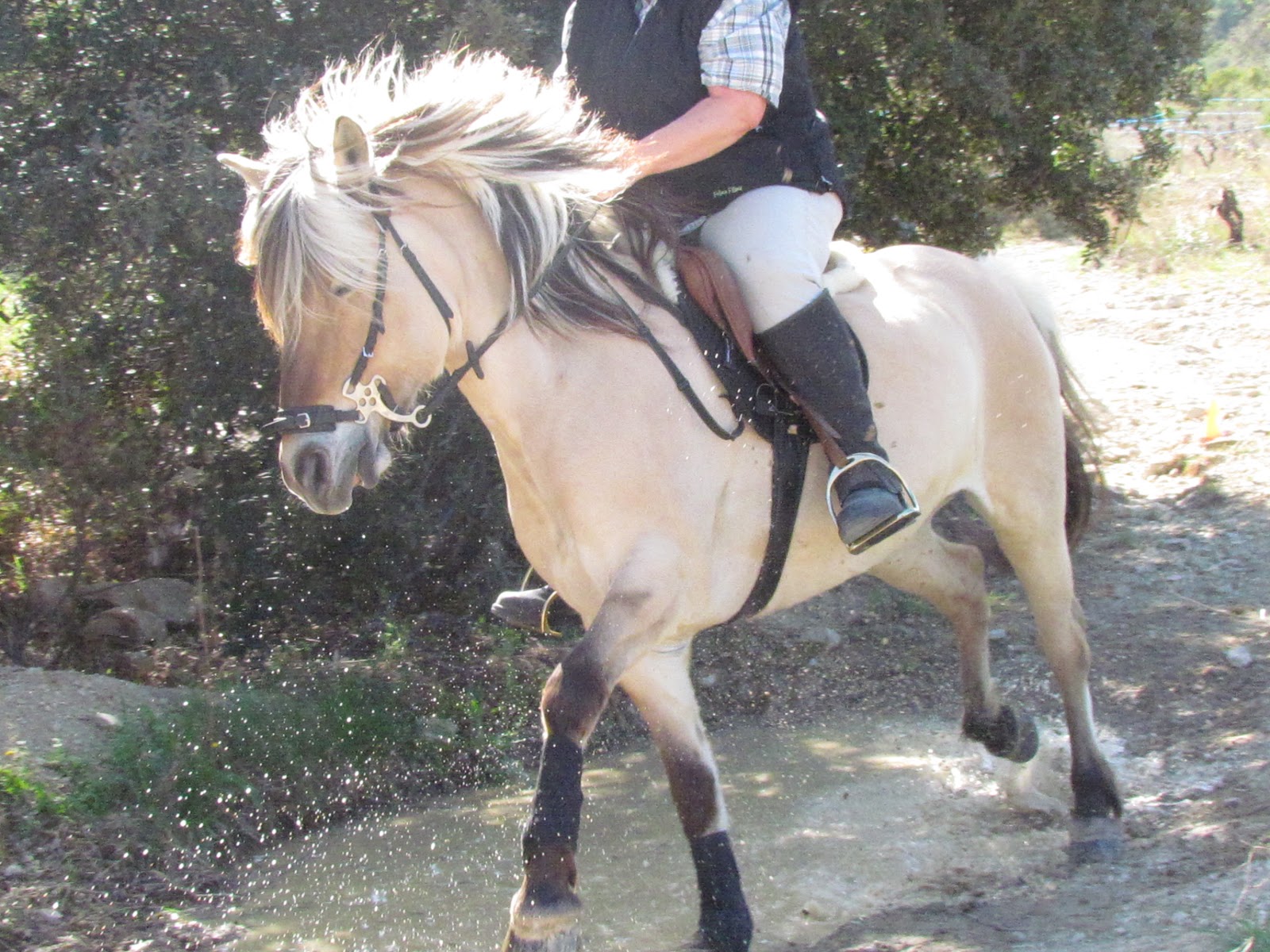
I decided to use our new techniques to work on our differences about puddles. We like doing trec competitions but May does not like water (the photo below shows her making sure she kept her feet dry in a competition last year) and there are usually water obstacles involved. If she sees a puddle on our routes, she makes sure she avoids them, however hard I try to push her in a straight line through them. Of course from a horse's point of view, a puddle could be 20 feet deep, they can't tell it is safe to go through so it is a matter of trusting the rider.
After the last heavy rain there was an enormous (at least ten feet long and four across) puddle across one side of the round pen at the club, so May and I worked on small circles on the parelli long line, then larger circles incorporating the edges of the puddle and working larger and larger until she was walking happily through the puddle parallel to me as well as in circles. The principle of the work on a rope at distance, and her respect of my space meant that she was obliged to put her trust in me and try the puddle. Once she realised she was not going to drown, a big step, she got quite excited about the whole thing and considered having a roll but thought better of it in the end. I was really proud of us both, that I had merited her trust and that I was able to ask her to hear me at the end of long rope.
The next day we repeated the exercise, firstly in just the ethological rope headcollar and then saddled and bridled but still with the headcollar. Then I tried it mounted, and after a small hesitation May went straight through, both ways. I was so proud.
This isn't the same as being out on the trail though, but it rained again last week and we went out for a little ride, and although May avoided the first puddle, after that she went straight through them all. I am so happy. We have a competition again in March so we will see how she goes.
But it was great to prove to us both that the natural approach is effective, so often you see people whipping their horses through water obstacles, it is really ugly. More often than not the horse eventually gives in, showing us their huge generosity of heart, but how much nicer to work with your horse so that they are happy to go through the water with you, instead of because they are too scared of pain not to?
Friday, 15 February 2013
Back in the saddle, just
When I started this blog last year, I was in good health, had a new, calmer horse than the one I regularly fell off before, and was preparing for a new season of pony games, having won the regional championship with our fantastic team of mothers "Les Incroyables". My daughter had just got her first horse on loan and we were thinking about months of lovely rides out and competitions and therefore lots of news for this blog. Oh No, it SO did not work out like that.
First I got bitten by monster horse, which left me unable to ride for weeks, then my back went and I couldn't ride for months. Then the pony games season started. At the second competition of the season la belle May, my lovely fjord mare, got so excited that we were winning one of our races that she put her head down between her front legs, and gave a little shake of her shoulders, thereby putting her backside in the air, at full gallop, thus catapulting me into the air, causing me to knock myself out and break a rib. So I couldn't ride again for three months.
So here we are. I rode again for the first time since 2nd December last week just at walk, and again this week at all paces. Most of me seems to work still but I have sadly hung up my pony games hat and have exchanged it for the toughest, thickest cross-country jockey-type skull cap that money can buy. It is silver, and hot, and does not look unlike a large saucepan covering my head, from my eyebrows to the bottom of my neck. Roll on summer!!
But May is still lovely and while I have been on the ground we have started to do a lot of "natural horsemanship" or ethology as it is called here, working with your horse in its language and building the relationship to enable us to work together with the lightest of aids. No whips or spurs or bits, just lots of love and fun. It is great, and May has turned out to be much more sensitive than I realised under all her bravado. More on that later but it makes riding much more satisfying when you have a real bond with your horse.
Monday, 26 November 2012
Horsey Mums
OMG, I have turned into a stereotype. I have become an English Horsey Mum, without even realising it. It came to me in a blinding flash last week after coaching my daughter a bit on her horse. Terrifying.
I am obviously dead cool, down with the kids and am unquestionably an original. But even if this is true the stereotype still fits (uncomfortably).
I wear an australian "cowboy" hat (albeit a real Barmah one), jeans, checked shirts, muddy boots, brightly coloured riding jackets and my hair is always a mess. I am of a certain age, comfortable size top and bottom and there is no question that I have a 'carrying' voice, (to put it mildly) with a slightly posh accent. I have a black labrador with me all the time. Also, I drive a VOLVO ESTATE WITH a tow bar, and I regularly pull a horse trailer in it. I can be seen at horse competitions on a regular basis shouting at my daughter while she competes in show jumping classes.
But it is the volvo that clinches it I think, or maybe the labrador.
I have NO IDEA how or when this happened. My daughter didn't even start riding until she was 13, two years ago, so I must have slipped into role very easily...
In my defence, having recently seen some other horsey mums screaming a diatribe of tellings-off at their kids when they miss a jump or fall off, or telling them before they enter the ring that they do not have the right to have a refusal or to knock down an obstacle, I think I am a very gentle type of horsey mum.
My screeches to my daughter when she is in the ring are always limited to "BREATHE" and "ALLEZ" and my instructions before she enters the ring are only ever "Enjoy yourself" and "smile".
I am still a bit worried though, I don't really want to be a horsey mum at all...
Friday, 23 November 2012
Back in the saddle and raring to go!
So here I am, with a lump the size of half an egg still on my arm after being savaged by a horse, but it hasn't stopped me at all. I was told by all and sundry that from now on I would be scared of horses, would never be comfortable again around them etc etc etc
However, nothing of the sort. I won't go near the horse that attacked me, not from fear, but because I really don't want to be bitten again, which reaction seems entirely sensible to me. But with all the other horses, nothing has changed and I am making up for lost time (while I had no left arm to speak of).
Since my last post the pony games season has started and I am delighted to report that our team of seniors (all over 40, all mums of younger riders) - "Les Incroyables" won our first competition. It was a crazy day, with high winds and gusts of 90kmp. The horses spent a lovely time jumping around in pretend fear of other ponies, bending poles, trees and everything else.
Between my daughter and I we now have competitions every sunday between now and Christmas, two pony games, one dressage and one jumping.
Woo hoo!
Tuesday, 18 September 2012
I don't want to put you off, but...

It hurts a lot.
Tuesday, 11 September 2012
Happy Tuesdays
Hunting has started again, as of 1st September, but each area has one day per week when the hunters have to stay at home (thank goodness as they really go for it on the other days around here). At Les Matelles and The Reganel (my club) no hunting day is Tuesday. Buffy (my dog) is terrified of the shots and although May is cool, I have no confidence whatsoever that the murderous hunters won't shoot one of us by mistake if we are out in the valley at the same time as them. I have read some real horror stories about riders and walkers being seriously injured by stray hunters' bullets and I have seen our local hunters gathering in the mornings and they look very capable of shooting a horse instead of a boar.
Consequently we now have to concentrate our ballades on Tuesdays and this evening was no exception. After a hideous bout of 'gastro', no doubt courtesy of the rentrée, today was my first day up. Despite feeling rather weak and pathetic I decided that we couldn't afford to waste a Tuesday evening, especially since the storms that had been forecast had not appeared, so the three of us took off at about six this evening for a gentle wander through the valley.
May is still so happy to be able to grip now without her back shoes that her idea of a gentle ballade is a lot quicker than mine, but it was so great to be outside after three days of incarceration that I didn't mind. We had a great, and tranquil, ride along the side of the valley and a couple of lovely canters, all the while beneath a stunning red sunset.
You just can't beat it.
Friday, 7 September 2012
Hoof Boots part 1
I am up to my neck in hoof boots, as we need them for six hooves - all four of Gump's hooves and probably two of May's (back). I took her back shoes off to stop her kicking Gump but also because she was slipping all the time, on the roads as well as the chemins and both of us felt very uncomfortable. We did a road test yesterday and it was amazing, May was striding out really confidently and was easily keeping up with the bigger horses, and we didn't slip at all. She was very happy even on the stones and rocks and she was sound today so we might get away with no boots, at least for slow ballades. Just as well perhaps as her hooves are extra long and narrow and I still haven't found a brand that will fit.
Gump's hooves change size every time he is trimmed by the equine podologue so I have already had to do two hoof boot orders and then send them back because they won't fit his new size. I am tearing my hair out. Each model of boot fits different shaped hooves, some come in pairs and others singly and each has a different sizing system so finding a set of four that will fit each hoof is killing me, the maths is too hard as well.
I am about to send the last lot back - it is just too expensive to make a mistake. You could nearly buy a small house in the Charente for the price of four hoof boots.
At the same time I am dying to buy the Tekna headcollar that is half price at the moment - synthetic so just washing under the tap instead of greasing the leather one. See earlier posts for my feelings on that. There are also lovely Tekna reins on special. I am sitting on my hands so I don't buy anything.
Saturday, 18 August 2012
To bath or not to bath?
I am english. In England we don't give our horses baths/showers to keep them clean because it is always so bloody cold we expect them to catch pneumonia. My old copy of "The manual of horsemanship" makes it quite clear that bathing or hosing a horse all over is a very dangerous activity which should only be attempted on a hot day, which they say is over 25 degrees. Well, according to my memories of the UK, that is about four times a decade. And that is in addition to the horror stories associated with using the wrong shampoo, not rinsing enough and the strong advice to wrap your horse in blankets immediately afterwards to make sure he doesn't die shortly after the cold, wet misery of the bath.
What a shock, then, to come to France and see the french riders' liberal use of the hose (with adjustable shower head, for fine spray, massage etc etc) sometimes DAILY on their horses. Admittedly there is a lot less showering going on in the winter but even then there are some tough types who get bathed even in the "winter" (quote marks just to point out that usually winter here in the Herault is mild autumn in the UK).
Every yard has a bathing area for the horses, with hose, place for shampoo and bath accessories, conditioner (yes, really) etc and it is perfectly usual practice to get off the horse, unsaddle, give the recompense (usually dry bread - another no no in the UK, but that is for another day) and then take the horse to the shower and liberally hose off all the sweat before tying them up again - no pre-warmed blankets, no fleeces (yes, horses have them too now), no woolly hats or mittens. The horses just dry off naturally.
It took me two years of regular riding in the Herault to get me into the habit of using the hosepipe other than on a horse's lower legs, and I felt hugely panicky and guilty every time I did it, even in temperatures of 30 degrees plus. Even now I usually stick to giving a quick rinse off around the saddle area rather than the full monty of head to tail wetting, shampooing, rinsing and sweat-scraping to get the drips off, and even then only on a particularly hot day if she has sweated a lot. Happily, my lovely mare May agrees with me that showers, particularly all-over ones, are not appropriate for horses. She has compromised though, and has let me know that in order to cooperate she expects a good double handful of pony nuts or there is no way she is going in there, and that she will be leaving, taking the fencing with her if necessary, immediately after the last mouthful has gone, regardless of how far along the showering process we are.
But on to the next issue - let the horse roll afterwards in the sandy school to help dry off, or make them hang around tied up until they are dry so they stay clean? Or just turn them out into their field? May and I go with the rolling option, May thinks that a good roll in the sand is necessary at least once a day unless it is dinner time in which case it can wait, but most importantly it is necessary after a shower. I find this is fine, the sand is clean and I can brush it out of her coat before I ride the next time. My daughter, with her first horse, went for the "turn straight out" option today, after finding it hard going brushing all the sand out of Gump's coat after he had rolled in the school.
Gump's owner (see previous posts) is coming to pay her first visit to him since he moved in with us, so J gave him a lovely big bath, all over, including washing the rather grubby white blaze on his face with a new, clean flannel. She scraped off the excess water with the sweat scraper and then turned him out into his field with May.
Within 30 seconds Gump had given us his view on all-over showers - he rolled vigorously and repeatedly in the lovely soft dust of his field and since he was still pretty damp, he got up looking like a hippo straight out of its wallow, absolutely plastered in dark brown mud.
I think I have got the message on baths, guys...
Thursday, 16 August 2012
I saw red squirrels living in the trees at our riding club...
how cool is that????
I love the Herault.
I love the Herault.
Thursday, 9 August 2012
Two horse family!
I haven't been riding at all because my back is so bad but we have had a new arrival - Gump! He is a 21-year-old Franche-Montagne horse - the national breed of Switzerland. I am putting up a pic of him. He has been borrowed for my daughter to ride as he is an ex competition horse and he is a darling. Sadly May is being horrible to him but they are living in a fantastic field with loads of room and lots of trees. Gump is a barefoot horse and because of the horrible behaviour by May I have had to take her back shoes off. So I am now involved in a whole new world of hoof boots - the choice is enormous and very expensive but more on that later...


Monday, 16 July 2012
Homogeneity in French riding - a GOOD thing!
In France, like most if not all sports, riding/equestrianism is organised at a national level, and teaching and standards are nationally organised. Like many english, I often find things "over-organised" here compared to the UK, which sometimes makes me wonder if the approach doesn't take all the individuality out of riding style and the fun too. However, what it does do is mean that you KNOW the standard of a rider according to their "official" level (or Galop - levels 1-7 at riding clubs, more in September). This is a good thing if you haven't ridden with somebody before. For example, this weekend there was a family from Normandy staying in the village, with their very bored, but horse-mad 12-year-old daughter. I invited her to come to the club with me to help me feed the horses, and because I knew her level I offered her a ride on la belle May, knowing that she would be able to manage her. Also, I found it really interesting that when she trotted, she did exactly the same as the kids at our club do - she held on to the mane with her inside hand and used her outside rein independently to control the speed and to keep the horse on the piste. I had never seen this technique in the UK (although I am very out of date) but seeing it used by somebody from a completely different region was cool, actually, and very reassuring. It means at the least that somebody trained by official riding teachers in France can ride at the correct level anywhere in France. So if they go pony trekking for example, they can immediately be given an appropriate horse for their level and by this be able to enjoy themselves the most. Likewise if they move to a different region they don't need to spend time learning the ropes in a new kind of riding school, they can just continue advancing.
I approve. I am surprised by this as usually I like things to be as idiosyncratic as possible, but for me it works.
Thursday, 12 July 2012
Leather tack vs synthetic
I have come to the end of my tether when it comes to cleaning tack. When I was a teen I cleaned my leather tack a couple of times a week, in front of the telly. I liked it! After my 30-year break from horse ownership I have come back to it having lost patience with leather. I can't stand the stickiness of the soap and the grease (even though I use nice vegetable-based oil and lovely posh NAF leather cream) or the SMELL! My hands are stinky for ages after I have cleaned everything. And the ages spent putting my leather hackamore back together with ten different tiny keepers (not really ten, but too many, anyway) and the leather wear on the sidepieces because of the weight of the hackamore. Its all too much now - and I am much busier it seems now then when I was 15! I just don't have time.
When I was in my teens synthetic tack was only just starting to appear in happy hacker/riding club world. I saw my first synthetic saddle then, already cracked and breaking and stiff and cheap-looking after only a few weeks of use. Rubbish. Everybody with any sense sneered at non-leather saddles. Only headcollars could be synthetic, in a small range of colours, green, burgundy, blue and red I think. Likewise saddlecloths and bandages - available in just a small range of very safe colours, and tendon or brushing boots generally in leather too, black or brown only, of course. I remember somebody buying some really "wild" navy blue exercise bandages once!
How things have changed! And all for the better in my view. Technology has moved on, with great new materials produced for industry and other sports (like sailing) being systematically adopted for use in equestrianism. I now use a synthetic saddle - only needs to be wiped over every now and again to keep it in perfect condition - bliss!! My synthetic saddle is adjustable, comfortable, fits my horse well and puts me in a great position. Despite having bought it second-hand from ebay (very cheaply!), it still has years left in it. And the girth straps, which will probably be the first bit to go, can be replaced by the cordonnier in the next village. My girth is synthetic too - so I shove it under the tap after every ride, making it much less likely that my mare will get girth galls compared to with a rarely-cleaned leather one.
My saddle is black, but it doesn't need to be any more - the new synthetic materials come in any colour you want - from classic black and brown to neon pink or orange, if you like. Your horse can have multi-coloured bridles and matching martingales - red, white and blue, for example, is popular. Most saddles are still black or brown but other colours are available. The most important thing about the new materials is how easily cleanable they are. The endurance world has adopted the new tack with a will - as one high-level endurance-riding friend said to me "you just chuck it all in the washing machine after a comp to clean it". Or just shove it under the tap after a ride. Now that is my kind of tack cleaning.
As for all the accoutrements - headcollars, saddlecloths, bandages etc - these are also now available in a rainbow of colours, and in fact in rainbow pattern too. While I stick to classic colours, my daughter rides with bright pink brushing boots and matching saddlecloth, it looks fantastic, I have to admit. Her neoprene-lined (i.e. lovely quality) headcollar is studded with "diamonds" - it looks great! I have seen fetlock and tendon boots to die for - tartan, leopard-spot print, zebra-striped and any colour you can think of. All with matching saddlecloths. Yum.
So right now, as I traipse off to clean my leather bridle yet again and spend a couple of days with stinky hands, I think it is time for that biothane synthetic bridle I saw on ebay...
Friday, 6 July 2012
Gymkhana!
The gymkhana was brilliant - I couldn't practice because my back was so bad but I took lots of ibuprofen and stuff and was ok. There were 32 riders in two groups, beginner and not beginner. As usual with these competitions at the club, I was the only adult. I am truly reliving my youth these days.
One of the ados rode too, on a comtois mare - that was something to see! Each group had to do a course in the fastest time with no faults. The beginners course involved a little slalom, going round a barrel, under a bar without touching it, ringing a bell and picking up a cup. Our group ( I really hoped F, one of the monitrices, would allow me to go with the babies but she wouldn't!) had to do much the same except with more turns, two jumps and picking up the cup with one hand, putting it under the neck of the horse, then going round a barrel and putting the cup back on a pole.
May was brilliant, she went off into canter from walk every time and on the right leg each time too. Our only problem was that she did her new shock reaction at the sight of an obstacle. She did this at our first le trec competition too and both then and yesterday I very nearly fell off as she jumped about six feet sideways at the sight of a (very tiny) jump like she had never seen one before! Given that she normally accelerates at jumps it is always very unexpected. However, I did manage to stay on and we carried on much better. But I rode about 15th out of 20 and I realised that there was one part where you could go very fast so we cantered quickly and then the kids after me all did the same and beat me hollow on their shetlands and little ponies (nippier than my fjord!!).
But of course it was all only for fun and it really was! May is so super brilliant, we had great fun and we got a rosette too!
Monday, 2 July 2012
My back is out!!
I had to make a flying visit to the UK last week and both ways by train plus dragging luggage about has put my back out. It is still the same nagging lower back problem caused when I had a bad fall from my gypsy cob mare, now nearly two years ago. The problem is that we have the annual gymkhana at our club on Wednesday and I am competing against the extremely capable children at the club with the beautiful new mare, May (see the pic) and I need to practice! They are all going to beat me anyway but it would be nice to give the kids a bit of competition!
Osteopath this afternoon - hopefully that will sort it out so I can practice tomorrow.
Osteopath this afternoon - hopefully that will sort it out so I can practice tomorrow.
Sunday, 1 July 2012
hoof oil vs water-based products and frying hooves
Now that the heat has come, my mare's hooves have become very dry and the annual angst about the best hoof products for her has begun. When I was young we used hoof oil and that was that, all year round, but mainly just for competitions. But that was in the UK, ie always damp! Now I have re-started my horse-life after a 20-year break, and here in France, and when I research UK sites, nobody seems to use hoof oil or grease any more, on the basis that it prevents water being absorbed by the hoof and makes it effectively impenetrable. So last year I started using NAF hoof moist but found it didn't go very far. I used aqueous cream too, as a cheaper version but that wasn't very effective either. I have been using REVIVET for cracked hooves as we had some shoeing problems and that was great, until the temperature rose. Now I have bought a huge tub of hoof moist because my pot of green hoof grease has disappeared from the tack room. It seems to be ok with my new mare but you do need to use it a lot. Finally, a weird question has been nagging my brain - if you cover the hoof in oil or grease in hot sunshine, will the hoof wall effectively fry? And if not, why not?
Horse people
There are horse people and non-horse people. I am a horse person. I loved horses from birth. I said the word horse (“horsie”) before I said “mama” or “dada”, I had dozens of horses (imaginary, plastic, furry and hobby) throughout my childhood and happily, real horses came in to my life at an early age and I never looked back.
Gymkhanas, trekking, show jumping, one-day eventing and eventually teaching followed.
I am a horse person. My daughter, too, found her passion for horses - later than me, but no less strong than my own. She too is a horse person, happy just to be near them. My husband, however, is not a horse person. He was first persecuted by equines at the tender age of 9 when he was asked to ride one by his mum, who suggested he go riding with his sister as he might like it. No. He HATED it from the first. He didn’t like anything about it. The horses were big and smelly. They trotted and he bounced painfully on his bottom and the teachers were horrible to him. It was a drab stables in London with nothing attractive about it. He cried. His sister laughed at him. He didn’t go again.
Horses continued persecuting him into his adult life. When walking in the countryside in Wales, where his family had a cottage, he would regularly encounter horses blocking his route, the size of houses (or horses), shuffling their feet in preparation for attack, showing their teeth as they blew flames from their nostrils and looking at him funny. And FOLLOWING him! WHY would they DO that?? He always found a quick escape and would abort his walks if there was no horse-free route. Then he met me, during a period when I wasn’t really doing anything horsey. The poor man. Tricked. We moved to France and I refound my horse world with a vengeance, and my daughter soon joined me. Now he finds himself a lone artist in a horse-obsessed family, with tack, boots, loose hairs and straw filling every corner of his house and a wife and daughter happy to discuss anything equine at the drop of a (riding) hat. For a while he put his foot down and banned all horse discussions at the dinner table on the basis that it was just too boring (and, speaking as a person who falls asleep at the first mention of perspective, colour, contrast, or anything art, I can sort of see his p.o.v). Then he realised he was fighting a losing battle and did a couple of beautiful drawings and paintings of the family equines (from photos, since he would never go nearer than two or three kilometers from them). Then, about six weeks ago he happened, completely by accident, to find himself inches from my beautiful fjord mare, who shoved her nose at him to introduce herself.
Automatically, he reached out his hand to stroke her nose and said “hello, May”, before realising what he had done, and backing up fast! Maybe there is a horse person somewhere in all of us?
Subscribe to:
Posts (Atom)